
Field Trip to Ken Matsumoto's Studio - October 15, 2025
2025-26
Wednesday, October 15, 2025
A Visit with Ken Matsumoto: Stone, Spirit, and Story at Art Object Gallery
On a lovely late morning in Japantown, San Jose, on October 29, 2025, ten LLAA docents,
joined by teacher and ceramicist Diane Levinson, gathered for a special visit to Art Object
Gallery, the studio and gallery of renowned sculptor Ken Matsumoto. What awaited us was
more than an art tour—it was an intimate encounter with an artist whose humility, depth,
and devotion to his art and the artistic world filled our souls and left us inspired.
LLAA docent Tony Misch, a longtime friend of the artist, set up this incredible visit for all of
us. As suggested by him, before our visit, some of us picked up sushi lunches from
nearby Nijiya Market on Jackson Street and walked over to the gallery on North 5th Street.
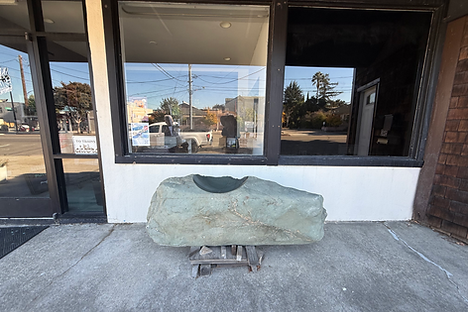
From the outside, Art Object Gallery looks inviting with a large, gorgeous, rock sculpture,
part organic, part polished and concave, reminding one of an oversized pointe ballet shoe,
or an undersized racing car, managing to be both natural and man-made all at once. Large
windows and the glass entrance door hint at more beauty within.
We, however, entered through the side, walking through the backyard which doubles as a
stunning sculpture garden and picnic spot, the art works all the more beautiful, juxtaposed
as they are in those surroundings. We barely had enough time to gawk at the beauty
around us before walking right inside to meet sculptor Ken Matsumoto.
Ken greeted us with an unaffected warmth that instantly put everyone at ease. He
graciously answered our many questions we had, starting with his entire personal history
and artistic trajectory. It was a privilege to hear his story of a life shaped as much by
circumstance as by an unrelenting love of art. Born and raised in Oxnard, one of seven
siblings, Ken discovered his artistic inclinations early, encouraged by the nuns at his
Catholic school. He started out in two-dimensional art, he said, recalling his early painting
days.
That path, however, took a sharp turn when he was drafted during the Vietnam War. In
1969, he found himself stationed in North Carolina, working not with weapons but with
pens, inks, and transparencies—creating mechanical drawings, illustrations, and visual
materials, some of which he said he still cannot discuss, conceding— with the
understated humor that marked our entire visit—that there’d been a lot of “hush-hush
stuff.” Surrounded by colleagues with advanced degrees in psychology and the social
sciences, he found his worldview expanding far beyond his Oxnard roots.
Ken’s father had requested that he not be sent into combat—a request granted because
several of his brothers were already serving in dangerous assignments. Ken admitted that
he was lucky, but with characteristic humility, he made light of all his hard work in the early
years. That experience—the blend of precision, structure, and survival—would later inform
his practice as a sculptor.
After leaving the military, Ken returned to California and studied art at San Jose State
University, where he eventually earned his Master of Fine Arts degree. He stayed in the
area, building not just a career, but a community.
Ken worked with many materials. However, his art took on a new direction when, in 1994,
he received the commission for the Arizona State University Tempe project “3 Benches,”
where his craftsmanship extended beyond the art itself, to designing and building his own
equipment, a skill he traces back to his army days. It enabled him to work with 30 tons of
Arizona sandstone and translate it into exquisite art. Ken showed us the scale model for
the project, explaining how his trademark carved and polished concave shapes derive from
the seats cut into the stone for “3 Benches” almost 30 years ago.
In time, he traded his smaller 7th Street space with the San Jose Redevelopment
Agency for the property that now houses Art Object Gallery. He opened the gallery not just
as a studio for his own work, but as a place to support other artists, showing and
promoting their work to help sustain the creative ecosystem he loves. It was born both out
of necessity and love for art and artists.
Designing and constructing his own stone-shaping tools is what he does to this day, and
we looked in awe at all the machinery in his studio. This mastery of both concept and
construction allows him to bridge the technical and the spiritual, creating works that feel
timeless yet deeply personal, part found, part fashioned.
His sculptures—primarily in stone—are at once visceral and ethereal. Standing before
them, one senses a dialogue between raw material and refined vision. The contrast
of rough, weathered texture and smooth polish in a single piece feels both deliberate and
meditative—a balance between chaos and serenity. “There’s something so Zen about his
work,” one of our group remarked (might have been me). His work is stunning in
photographs, yes—but in person, it truly breathes.
As we toured the gallery and adjoining studio, which displayed both his art and that of
other artists, Ken graciously fielded questions about materials, process, philosophy, and
the unpredictable path of an artist’s life. His responses were thoughtful, often selfeffacing,
and tinged with humor. He spoke not as a distant expert, but as a fellow traveler
still in love with the journey. We ended our visit sharing lunch and conversation, surrounded by Ken’s art. The space
buzzed with curiosity and admiration — a happy hum of creativity and community colliding
(gently).
We left the Art Object Gallery that afternoon both humbled and uplifted. Ken Matsumoto’s
sculptures embody balanced stone and spirit, discipline and freedom, simplicity, and
mystery. In his presence, those same qualities come to life.
Docents, Elisabeth Bonnet, Joseph Coha, Lisa Dearborn, Suman Ganapathy, Julia Hartman, Amy Mears, Tony Misch, Char Nagayama and Kim Worrall attended the field trip.
To view more of Ken's art, visit his website at: https://www.artobjectgallery.com/ken-matsumoto
Text submitted by Suman Ganapathy and Tony Misch
Photos provided by Suman Ganapath, Tony Misch and Amy Mears


